
Creating Sacred Space
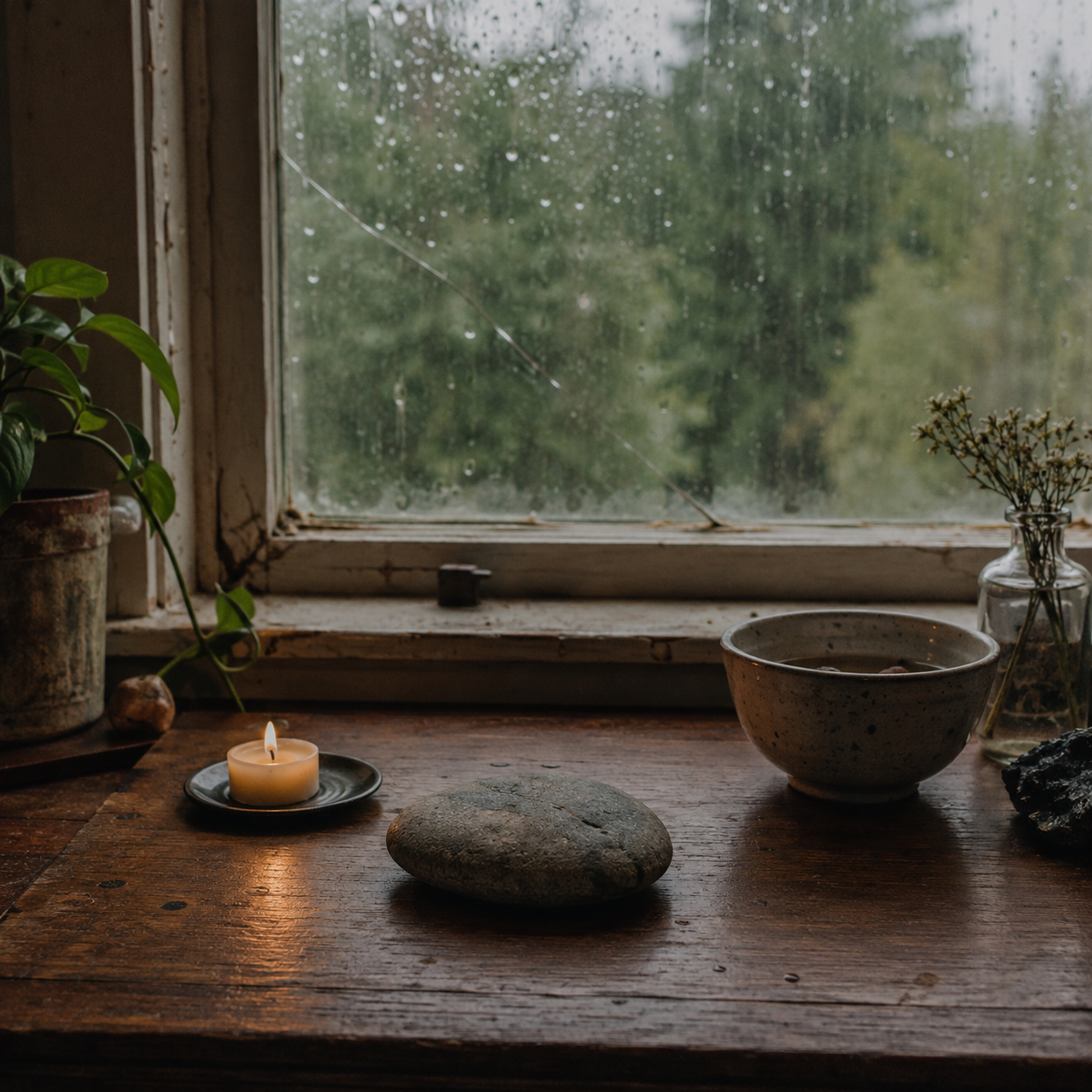
I remember standing barefoot at my first altar in my living room one rainy morning, incense smoke curling toward the cracked kitchen window. I must have moved that river stone eight times. The candle moved with it. Then the bowl. Then the stone again. I was trying to figure out where everything was supposed to go. Was north supposed to be earth? Was I even facing north, or just facing the direction that felt like it might be north?
I was determined to get it right. Outside, wet cedar branches dripped steadily onto the railing, patient and unconcerned. Eventually I stopped rearranging things. I had spent so much time worrying about where the stone belonged that I’d just about forgotten why I’d put it there in the first place.
I put the stone where I could see it. The candle went where I wouldn’t knock it over. The bowl went near the window because I liked the light there. I stopped trying to make my altar look like the diagram in the book and put things where I could actually use them.
Tradition should be a compass, not a cage.
Start Where You Are
There is nothing wrong with having a framework. When you’re learning something new, a framework can give you somewhere to begin. Learning why a particular tool or correspondence is used can also tell you a lot about the tradition you’re studying.
But before I decide I need a particular tool, I like to ask what I’m actually trying to do.
I’ve used plenty of ordinary things in my own practice. A kitchen bowl holds water just fine. A notebook doesn’t become less useful because it came from the stationery aisle instead of a metaphysical shop. Sometimes the thing I need is already sitting in front of me.
A framework should help you practice. It shouldn’t become another thing you have to get right. Pay attention to what helps. Keep what works. Change what doesn’t. You can always add something later.

Working With Your Tools
Sometimes you won’t know how something works for you until you’ve tried it a few times. A wand might feel natural in your hand. Or it might feel like you’re trying to conduct an orchestra with a broken umbrella. A particular stone might help you settle your attention. Another might spend six months gathering dust because you keep forgetting it’s there.
That’s useful information. Pay attention to what happens when you work with something. Does it help you focus? Does it make a particular kind of practice easier? Does it feel natural to use, or are you spending more energy worrying about whether you’re using it correctly than actually doing the work?
You can also let tools change roles. Something you chose for one purpose might become useful for another. A notebook can hold spell notes, dreams, observations, or the questions you’re not ready to answer yet. A bowl can hold water, herbs, offerings, or whatever the work calls for. A stone might become a familiar grounding object simply because you’ve carried it with you often enough.
And not everything has to become precious. Some things are meant to be used up. Candles burn down. Herbs get scattered or steeped. Incense disappears into the air. Their meaning doesn’t depend on keeping the physical object forever. The practice continues when you replace them.
That’s part of learning your tools, too: noticing what you actually reach for, what you use often, what you adapt, and what you eventually stop needing. You don’t have to make every tool part of your identity. Use what helps. Take care of what you keep. Let go of what doesn’t.


Preparing Your Tools
There are a few words you’ll run into when people talk about preparing tools for magical practice: cleansing, consecrating, dedicating, and charging.
They can sound like four completely different ceremonies you need to learn before you’re allowed to use anything. They aren’t. At their simplest, they’re different ways of getting an object ready for the work you want to do with it.
Start clean. If something is dusty, dirty, or carrying the residue of where it came from, clean it. Soap and water when that’s appropriate. Wipe it down. Let it dry. You don’t need a complicated ritual to begin. That’s cleansing in its most practical form: clearing away what you don’t want to carry forward.
There are plenty of other ways people cleanse tools, too. Smoke, sound, water, salt, sunlight, moonlight, and deliberate intention are all used in different practices. What matters is choosing a method that makes sense for the object and your practice. Not everything needs to be dunked in salt water, and some things will absolutely regret that decision.
Consecrating or dedicating a tool is about purpose. You might decide that a particular cup is going to be used for offerings, that a stone will be part of your meditation practice, or that a knife has a particular role in your magical work. You can say that aloud, write it down, pray over it, or simply make the decision clearly in your own mind. You’re giving the object a place in your practice.
Charging is a little different. This is where you focus an object toward a particular intention or purpose. You might hold it while you visualize what you want it to support, speak an intention over it, pray, work with energy, or use another method that makes sense to you.
And then? Use the thing. That’s the part I think sometimes gets lost. You don’t need to spend three weeks preparing your tarot deck before you can pull a card. You don’t need an elaborate ceremony every time you pick up your wand. Sometimes preparing a tool is a meaningful ritual in itself. Sometimes it’s five minutes of cleaning something, deciding what you’re going to use it for, and getting on with your practice.
And if you’re not sure? Clean it, decide what you’re doing with it, and start.
Building an Altar That Works for You
Before deciding what belongs on your altar, decide what you want the altar to do.
An altar can be a place for magical work, a space for devotional practice, a focal point for meditation or prayer, or some combination of those things. It might hold the tools you use during a spell, objects connected to a deity or ancestor, seasonal items, or simply something that helps you settle into practice.
What you put there depends on what you want to do there.
If you’re building an altar for spellwork, start with the things you actually use. If it’s devotional, give the things you’re honoring a place that feels appropriate. If it’s somewhere you meditate or observe the seasons, you may need very little at all.
Then build around the practice rather than the picture of an altar you’ve seen somewhere else.
Making Space Sacred
You don’t need a special room to create sacred space. You need a place where you can give your attention to what you’re doing.
Start by making the space usable. Clear the dishes from the table. Move the laundry off the chair. Put your phone somewhere it won’t demand your attention. Open a window if that helps you settle in. Dim the lights. Light a candle. Do whatever helps you mark the difference between ordinary time and this is where I’m practicing now.
You can also bring something into the space that helps you focus. A stone you’ve collected. A plant. A candle. Music. A particular scent. A prayer or a few quiet words. Maybe it’s simply sitting down and taking a few breaths before you begin.
There doesn’t have to be a dramatic transition. Sometimes the ritual is the transition.
If you’re working outdoors, you may not need to change the landscape at all. Choose a place where you can sit safely and without disturbing what lives there. Notice where you are. Feel the ground beneath you. Listen to the weather, the birds, the insects, the traffic in the distance. Let the place itself become part of what you’re paying attention to.
And when you’re finished, let the space become ordinary again.
Blow out the candle. Put the tools away. Clear the table. Pick up anything you brought outside. If you’ve made a temporary altar, return the space to what it was before you began.
Sacred space doesn’t have to stay sacred forever to have been sacred while you were there.
Sometimes creating sacred space is nothing more complicated than deciding: for the next little while, I’m going to be here on purpose.
Back to Ordinary Life
I still have that river stone.
It isn’t always on my altar. Sometimes it sits on a shelf. Sometimes it ends up in a pocket when I’m heading out for a walk. Every now and then I find it somewhere completely unexpected and remember that rainy morning when I was so determined to put everything where it belonged.
These days, my sacred spaces tend to change with whatever I’m doing. Sometimes there’s a proper altar. Sometimes there’s a cup of tea on a windowsill. Sometimes I’m outside with nothing but a pocket full of seeds and a little time.
I used to think I needed to get the arrangement right before I could really begin. These days, if the stone is somewhere I can see it and the candle isn’t going to get knocked over, I’m probably doing fine.