
Beltaine
May / November
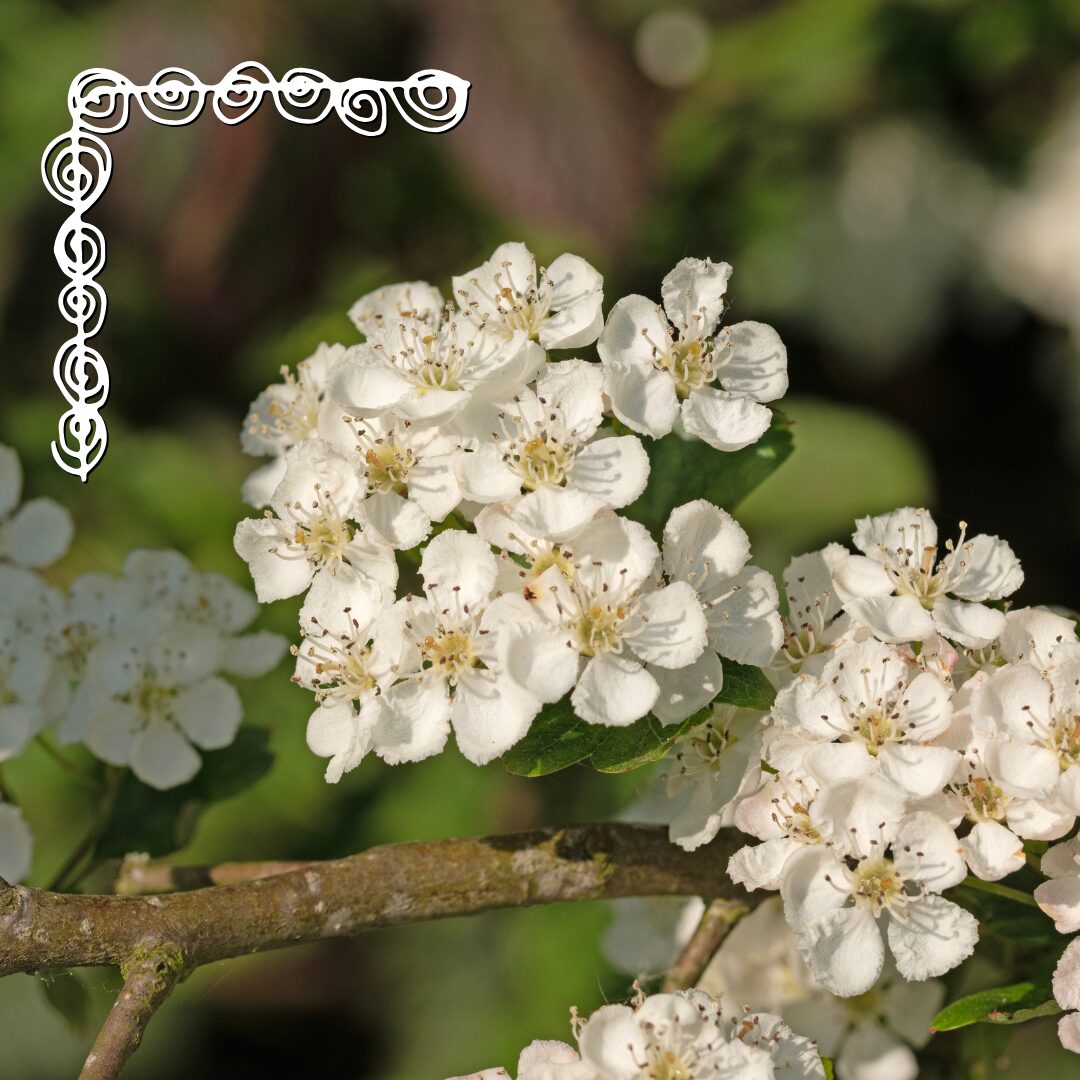
The hawthorn is blooming. I noticed it this morning while I was letting the chickens out, that unmistakable cloud of white along the fence, and I stopped with the feed bucket still in my hand. The ducks complained. I didn’t care. The ground is covered in petals from the fruit trees, leading my eyes to the dogwood – also covered in white blossoms. The blend of sweet and musky scents on the breeze always smell a little wild, maybe even indecent – and just like that I’m twenty-five again, standing in a field somewhere, feeling the particular electricity that lives in late spring air.
Beltaine doesn’t announce itself gently. It arrives the way desire does: suddenly, completely, with little patience for hesitation. Growth no longer asks permission. It surges. The garden stretches, the trees leaf out in full confidence, and something in the bones stirs awake whether you’ve given it leave or not. The world has been building toward this for weeks, the lengthening days and warming soil, and then the hawthorn opens, and you know. The fire half of the year has begun.
What Is Beltaine?
Beltaine falls on the first of May in the Northern Hemisphere, opposite Samhain on the Wheel of the Year. Where Samhain draws us inward, Beltaine calls us out into the living world. It is the festival of fire and fertility. Not only in the narrow sense, but in creativity, in passion, in the spark that brings ideas into being. Life at its most vibrant and unapologetic. This is one of the four great Celtic fire festivals, and it marks the beginning of summer by the old reckoning, not the astronomical summer solstice, but the pastoral one, the season when the world is actively, insistently alive.
This is not a quiet sabbat. It asks nothing of your stillness, but of your willingness to show up fully. The weaving together of energies that have been stirring quietly since Imbolc and stretching themselves at Ostara, now meet. They ignite in Beltaine’s bonfire. This is the abundance before the harvest, the peak before the long slide toward autumn. Life is not whispering here. It’s shouting from every branch and burrow and bloom. Gone are the days of planning and waiting. Beltaine asks: what will you do with what has begun to grow? It is not a gentle question, but it is an honest one.
History and Mythology
Imbolc has deep roots in pre-Christian Ireland and the wider Celtic world. It is one of the four Gaelic seasonal festivals. Imbolc became closely associated with Brigid, a goddess of fire, poetry, healing, and smithcraft. Some traditions hold that Brigid was born at sunrise, standing on a threshold with one foot inside and one foot outside, fed on milk from an Otherworldly cow – a fitting origin for a goddess of liminal spaces and thresholds. Later, she was carried forward as Saint Brigid, a rare continuity that speaks to her enduring importance, and the day was Christianized as St. Brigid’s Day. She walks still through this holiday whether the church likes it or not.
At Imbolc, traditional practice involved leaving offerings for Brigid – food, drink, cloth strips tied to trees. People made Brigid’s crosses from rushes, wove corn dollies, kept candles burning through the night. Brigid is a threshold goddess herself, standing between hearth and forge, inspiration and labor. She watches over the liminal spaces where one thing becomes another. Myth tells of her as a bringer of fertility and protection, and in some traditions, as a guardian of the sacred flame. Some mark this as the birth of the sun child in the cycle of God and Goddess, the young light growing stronger day by day.

Themes and Symbolism
The themes of Beltaine are not shy things. They arrive like flame – bright, consuming, impossible to ignore. At its heart, this sabbat is about vitality, creative power and union. The energy here is outward, expressive, generative. It wants to *make* something. The theme of union, which many reduce to romance or sexuality, but they are not the whole of it. Union is about bringing harmony between forces – inner and outer, seen and unseen.
Fire is the great symbol here. Not the controlled candle flame of winter rituals, but the bonfire. The kind that crackles and throws sparks into the night sky. Fire transforms, it illuminates, it draws community together, it marks boundaries. And then there is the green world itself: flowers, leaves, the riot of growth. Every herb in my garden seems louder this time of year. The lavender pushes upward, the oregano spreads as if it owns the place (which, frankly, it does), and the whole yard hums with life.
The symbols of the maypole and the cauldron, the joining of the masculine and feminine principles, appear throughout Beltaine practice. This needn’t be read literally or in only one way. At its heart, this symbolism speaks to the creative power that emerges when complementary forces meet and dance. Beltaine reminds us: you are part of this. Not separate. Not above it. Part of the same wild, growing thing.
Beltaine Rituals and Traditions
Seasonal Correspondences
The hawthorn will drop its blossoms in a few weeks. The garden will become its summer self, demanding and abundant. That’s what I love about this sabbat, honestly. It doesn’t traffic in subtlety. After months of quiet tending, of watching for first light and early blooms and the cautious return of warmth, Beltaine simply arrives and says: enough watching. Begin.
As beltaine draws to a close, there’s often a moment—usually just after sunset—when you realize something has shifted, even if you can’t quite name it. I feel it every year, standing in the yard as the last light fades behind the trees, the scent of smoke and herbs lingering, the world quiet. It’s just me, the land, and the slow turning of the wheel.
Bide your time no longer. The fire half of the year is here.